Veneer applied to plywood has some challenges - what do you do about the
edge which shows the stacked plys? You can either apply veneer edging or
something a little bit thicker. For this project I wanted a 1" radius
corner. On a previous
post I had discussed how to glue a similar species
wood on the edges and route rounded corners using a circle jig. For a
radius smaller than the router base, you need a different solution.
Here I have glued strips of real mahogany to the sides of the plywood and want to round the corner. For the veneer, I'm using sapele which looks similar to mahogany, but is much cheaper. To create the small radius corner, I need to use a template and a straight router bit with a bearing.
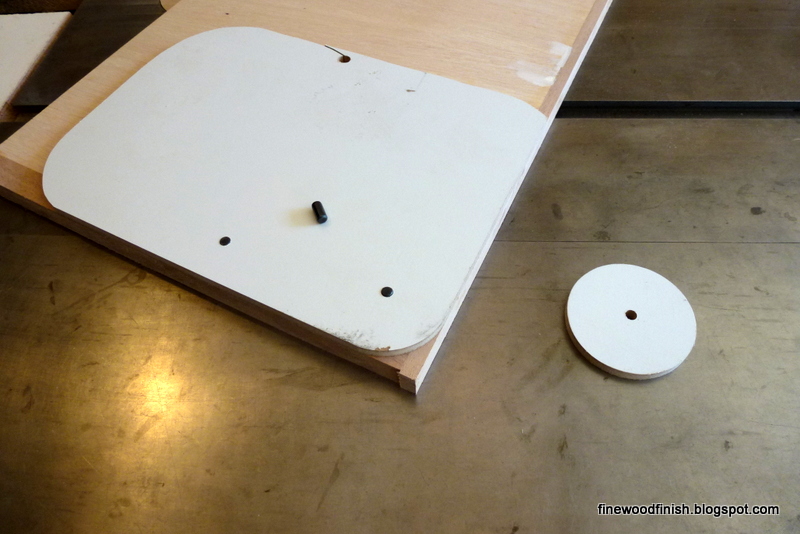
My second requirement is to use my router table because when I clamp my template to the plywood, the clamps interfere with the router. The circle on the right side was made with a hole cutter used for drilling a house door to accommodate a handle. I then created the template by aligning the circle to the sides of the template workpiece. A ¼" metal dowel pin (shown on the template) secures the circle and allows me to replicate the curve on the template.
With the template created, I need to align its sides to the sides of my workpiece. Another ¼" hole is needed to prevent the template from rotating on the workpiece. Two metal dowel pins are shown here sticking out. Now I can use the template to guide the router around the corner.
This technique works because the veneer will cover the holes. So now, I simply fill the holes and glue on the veneer.


 Veneer applied to plywood has some challenges - what do you do about the
edge which shows the stacked plys? You can either apply veneer edging or
something a little bit thicker. For this project I wanted a 1" radius
corner. On a previous post I had discussed how to glue a similar species
wood on the edges and route rounded corners using a circle jig. For a
radius smaller than the router base, you need a different solution.
Veneer applied to plywood has some challenges - what do you do about the
edge which shows the stacked plys? You can either apply veneer edging or
something a little bit thicker. For this project I wanted a 1" radius
corner. On a previous post I had discussed how to glue a similar species
wood on the edges and route rounded corners using a circle jig. For a
radius smaller than the router base, you need a different solution.